

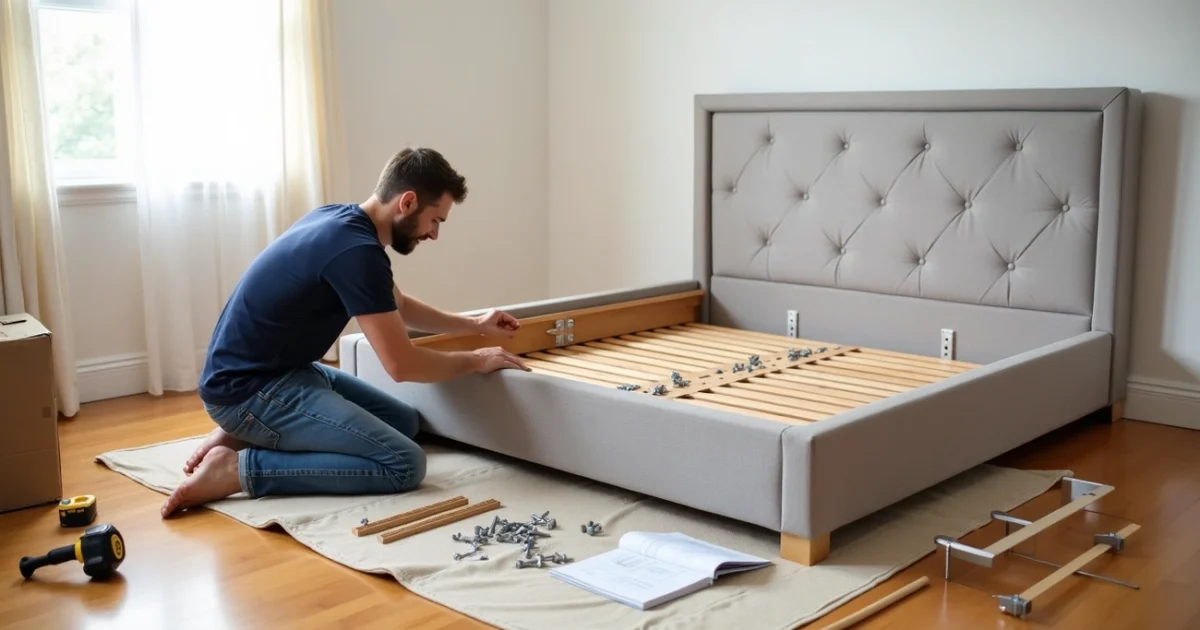

Struggling with bed assembly and all those confusing parts scattered across your floor?
What makes bed assembly successful every time?
Here’s what we’ve learned from years of helping people build their perfect sleeping space:
• Start with proper preparation: Check every part against the manual, gather the right tools (that ratcheting screwdriver saves hours), and clear 2-3 feet of workspace around your assembly area.
• Stick to the proven sequence: Lay out components first, assemble the main frame loosely, square those corners, then tighten bolts using a star pattern for even tension.
• Mind your slat spacing: Keep gaps no more than 2.5-3 inches between support slats. Wider spacing means mattress sagging and voided warranties.
• Test everything before sleeping: Wobble tests at each corner, smooth gas lift operation checks, and systematic tightening of all connections prevent future headaches.
• Plan for 1.5-4 hours: Most people finish within this timeframe, making it a perfectly reasonable weekend project.
These tips help you avoid loose joints, annoying squeaks, and structural problems whilst ensuring your bed serves you well for years.
Ottoman bed assembly might seem overwhelming, but here’s what surprises most people: you can complete it in just 1.5 to 4 hours.
Not bad for adding valuable storage space to your bedroom, right?
Whether you’re working through gas lift ottoman bed assembly instructions, following ottoman storage bed assembly instructions, or tackling ottoman bed frame assembly for the first time, having a clear plan makes all the difference.
We’ve put together this guide to walk you through every step. You’ll discover universal assembly principles that work for all bed frames, specific instructions for different bed types, and expert tips to avoid common mistakes.
Ready to turn that intimidating pile of parts into your perfect bed?
What should you do before starting assembly?
Why check every part first?
Unpack your bed frame with care. Lay components on a soft surface like carpet or a rug to prevent scratches or dents during this initial stage. Read the assembly instructions thoroughly, then match each part against the diagrams provided. This step prevents confusion when pieces look similar but serve different purposes.
Check all screws, brackets, bolts, washers, nuts and other fasteners against the parts list. Missing a single component now saves frustration later. If parts are absent, contact the supplier immediately before starting assembly.
Which tools make assembly easier?
Most bed frames include basic tools, but having additional equipment speeds up the process significantly. You’ll need:
- Allen key (usually included with the frame)
- Ratcheting screwdriver with hex bits (can reduce assembly time by more than half)
- Rubber mallet (for gently tapping tight-fitting joints without damaging finishes)
- Magnetic parts tray or bowls (prevents losing small hardware)
- Utility knife or box cutter (for opening packaging safely)
- Measuring tape (for positioning accuracy)
- Standard screwdriver (for securing fittings)
A power drill with clutch control can help, but manual tools work perfectly fine for most ottoman bed assembly tasks.
Where should you assemble your bed?
Clear significantly more space than you think necessary. Aim for two to three feet of open area around the entire footprint of your finished bed. This gives room to manoeuvre large pieces like headboards and side rails without bumping walls or furniture.
Assemble in the room where your bed will eventually live. Moving a fully assembled bed frame through doorways creates unnecessary hassle. Select a well-lit location to see hardware clearly and avoid misaligning parts.
How do you protect your floors?
Cardboard from the bed frame packaging provides adequate floor protection for most assembly projects. Lay sheets under your work area to prevent scratches from dragging or dropping components.
For hardwood or laminate floors, place felt pads under each bed leg before sliding the frame into position. Rubber pads work well too, though they may leave scuff marks on certain floor types. Choose thick felt for heavier furniture to ensure proper protection.
Moving blankets offer another option, creating a soft surface for dragging heavy items without causing damage.
The Step-by-Step Process That Works for Every Bed Frame
Sort Everything Before You Start
Spread every piece across your workspace like you’re conducting an orchestra. Group similar items together: side rails here, slats there, hardware sorted by type in small bowls. This isn’t just organisation for the sake of it – when pieces look nearly identical, this sorting prevents costly mistakes later.
Cross-reference each component with your instruction manual diagrams. Trust us, taking five minutes now saves an hour of frustration when you’re halfway through assembly.
How do you build the main structure without it falling apart?
Connect the big pieces first, but here’s the secret: don’t tighten anything completely yet. Attach side rails to the headboard using those pre-drilled holes as your guide. Leave bolts loose enough for adjustment. Do the same for footboard connections. You’ll have a complete but wobbly rectangle.
Now grab a helper and gently nudge the frame until all corners form perfect 90-degree angles. Your eyes work surprisingly well here – no fancy tools needed. Once you’re satisfied with the shape, tighten bolts in a star pattern, just like changing car tyres. Start with one bolt on the headboard, then jump to the diagonally opposite one on the footboard. This technique distributes tension evenly, pulling the frame into a properly square shape.
Headboard and Footboard Assembly
Split headboards need full assembly before attaching to the frame. Remove all packaging and place the headboard face-down on your carpet. Line up the halves perfectly and screw bolts into those predrilled holes behind the fabric backing. Some frames include an additional wooden support plank – place it on the predrilled holes and screw in. If holes don’t align, simply flip or rotate the plank.
Watch for pre-installed dowels on the headboard before securing with bolts. Apply this same method for side frames.
What about the side rails?
Position side rails with finished sides facing outward – you’d be surprised how often people get this wrong. Secure connections using supplied hardware, checking alignment constantly. One misaligned rail throws off the entire frame.
Slat Spacing: Why This Detail Matters Enormously
Here’s where many people go wrong: slat spacing must stay within 2.5 to 3 inches apart. Wider gaps risk mattress sagging and warranty voids. That’s not a suggestion – it’s a requirement.
For queen and king-sized beds, the centre support beam prevents slats from bowing under weight. Adjust support legs until they make firm floor contact. Here’s a simple test: slide paper underneath. If it glides through easily, lower the leg further.
Different Bed Frames, Different Approaches
What makes one bed assembly different from another?
Each frame type brings its own quirks and requirements. Let’s break down the specific approaches you’ll need.
Ottoman Bed Frame Assembly
Looking to master the basics first?
Start by attaching headboard and footboard legs using allen keys and screws. Create the perimeter by securing side rails, then install cross support rails for that crucial structural integrity. Connect front, back, left and right rails before moving to the mechanism installation.
Simple enough, but the real magic happens next.
Gas Lift Ottoman Storage Bed Assembly
Here’s where things get interesting. Gas lift ottoman bed assembly instructions demand careful attention to those hydraulic components. Position the bed head, foot and side rails where your bed will actually sit, noting the gas lift struts pre-attached closer to the head end. Hook side rail brackets onto head brackets, securing with button head bolts finger-tight only.
Lift the gas lift arm and align the bolt with the support strut hole. Place the support strut over the bolt and secure using lock nuts. Position the slat frame on gas lift struts, aligning holes along the sides. Use mushroom head bolts to secure, adjusting the slat frame forward or backward as needed.
For queen and king beds? Fit support legs to the centre rail, ensuring the foot sits just above the floor when closed.
Platform Bed Assembly
Want to skip the box spring entirely?
Platform beds eliminate that need completely. Install the platform or slat system ensuring proper spacing for mattress support and air circulation. Solid platforms slide into grooves or rest on ledges.
Straightforward and efficient.
Divan Bed Assembly
Divan assembly proves remarkably simple. Attach gliders to each corner using a rubber mallet. For double beds and larger, flip both bases, locate pre-drilled holes and insert link bars, screwing nuts into both sides. Pierce headboard stickers to expose screw fixtures and attach headboard struts.
Metal Bed Frame Assembly
Set side rails parallel, attach feet or wheels, then extend cross arms perpendicular to frame legs. Overlap side arms to the correct width and lock together.
Wooden Bed Frame Assembly
Attach headboard legs using allen keys, screws and wooden dowels. Secure footboard legs identically, then connect side rails and cross bars without fully tightening. Insert centre support bar and support legs before securing slats.
Handmade in Yorkshire · Free UK delivery
Ready to find your perfect bed?
Ottoman storage, divan, upholstered and TV beds, handmade to order and sold factory-direct. Order free fabric swatches before you choose.
How do you know if your bed assembly actually worked?
Testing comes next. You’ve spent hours putting everything together, but does it actually hold up?
Does your bed feel solid and stable?
Give each corner a proper shake. Apply pressure and see what happens. A properly assembled bed shows no creaking or movement. The headboard and sides should feel absolutely rigid when you shake them with moderate pressure. Bed slats? They can flex slightly – that’s normal.
Press down on different sections whilst turning over to simulate actual use. Think about it – you’ll be moving around on this bed every night for years to come.
Are your ottoman lift mechanisms working smoothly?
For gas lift ottoman beds, pull those foot straps and check the hydraulic action engages properly. The struts should lift the mattress base without fighting you. Weight distribution in the storage compartment matters too – exceeding load limits makes lifting a struggle.
Check for obstructions that might hinder closing. If friction develops, apply silicone-based lubricant to gas struts. Both struts need to align correctly to prevent uneven lifting.
Have you tightened everything properly?
Go through every bolt and screw systematically using appropriate tools. Corner bracket fixings deserve special attention – cheaper fixings work loose over time. Apply firm pressure but avoid overtightening, which strips threads.
Still hearing wobbles or squeaks?
Loose joints cause most wobbling issues. Retighten all fasteners first. Check if your floor sits level – use shims under legs if needed.
For squeaking, apply beeswax or silicone lubricant to wooden joints. Add plastic washers between metal components to eliminate noise. These small fixes make the difference between a bed that annoys you and one you actually enjoy sleeping in.
Conclusion
You now have all the knowledge needed to assemble any bed frame with confidence. All things considered, proper preparation and following the right steps make the difference between a frustrating afternoon and a satisfying project. Buy the perfect luxury bed at a reasonable price by visiting our online showroom. Above all, take your time, check your work, and you’ll soon enjoy a sturdy, beautifully assembled bed for years to come.
Need a hand choosing your next bed?
Explore our handmade ottoman storage beds, or message us on WhatsApp and we’ll help you pick the right size and fabric.
FAQs
Q1. How long does it typically take to assemble an ottoman bed? Most people complete ottoman bed assembly in approximately 1.5 to 4 hours, depending on the complexity of the frame and their experience level. Having all the necessary tools ready and following the instructions carefully can help you complete the task more efficiently.
Q2. What tools do I need to assemble a bed frame? You’ll need an Allen key (usually included), a ratcheting screwdriver with hex bits, a rubber mallet, a magnetic parts tray for small hardware, a utility knife for packaging, measuring tape, and a standard screwdriver. Whilst a power drill can be helpful, manual tools work perfectly well for most bed frame assemblies.
Q3. Can I use a platform bed without a box spring? Yes, platform beds are specifically designed to eliminate the need for box springs. They feature either a solid platform or a slat system that provides adequate mattress support and air circulation on its own, making them a practical and space-efficient alternative to traditional bed setups.
Q4. What’s the most common mistake when assembling a bed frame? Using incorrect screws or fasteners is a frequent error that can damage the frame. It’s essential to sort and label all fasteners before starting assembly, match each component against the instruction diagrams, and avoid forcing parts into place. Another common mistake is fully tightening bolts before ensuring the frame is properly squared.
Q5. How can I fix a wobbly or squeaking bed frame? For wobbling, first retighten all fasteners systematically, paying special attention to corner bracket fixings. Check if your floor is level and use shims under legs if necessary. To eliminate squeaking, apply beeswax or silicone lubricant to wooden joints, and add plastic washers between metal components to reduce friction and noise.